RGUHS Nat. J. Pub. Heal. Sci Vol No: 17 Issue No: 4 pISSN:
Dear Authors,
We invite you to watch this comprehensive video guide on the process of submitting your article online. This video will provide you with step-by-step instructions to ensure a smooth and successful submission.
Thank you for your attention and cooperation.
1Dr Supriya L B, Senior Lecturer, Department of Prosthodontics and Crown and Bridge, Bapuji Dental College and Hospital, Davangere, Karnataka, India.
2Department of Prosthodontics and Crown and Bridge, College of Dental Sciences, Davangere, Karnataka, India
3Department of Prosthodontics and Crown and Bridge, College of Dental Sciences, Davangere, Karnataka, India
4Department of Prosthodontics, Government Dental College and Research Institute, Bangalore, India
*Corresponding Author:
Dr Supriya L B, Senior Lecturer, Department of Prosthodontics and Crown and Bridge, Bapuji Dental College and Hospital, Davangere, Karnataka, India., Email: supriyalb637@gmail.com
Abstract
Background: Ideally a denture base material should possess biocompatibility, ease of fabrication, high fracture resistance, and good aesthetics. Over the years different approaches were considered to improve the properties of basic materials to improve clinical results. In the due process, newer materials came into clinical usage because of their better properties.
Aim: The study aims to evaluate Water sorption, Solubility, and Flexural strength of High-impact Polymethyl methacrylate with two commercially available flexible resins.
Methods: High-impact polymethyl methacrylate (PMMA) was used as the control group in the investigation. The study included the assessment of Water sorption, Solubility, and Flexural strength of three different materials. The results obtained were tabulated and put through the statistical analysis.
Results: According to the results, valplast a thermoplastic resin demonstrated higher values for flexural strength when compared to the other two materials, whereas standard PMMA displayed higher values for water sorption and solubility when compared to the flexible resins.
Conclusion: Thermoplastic resins showed better results with water sorption, solubility and flexural strength when compared with conventional polymethylmethacrylate resin materials.
Keywords
Downloads
-
1FullTextPDF
Article
Introduction
A wide diversity of materials has been used in denture construction since ancient times. The optimal denture base material should have a number of important characteristics, including radiopacity, biocompatibility, good aesthetics, strong bonding with denture teeth, ease of repair, and sufficient mechanical and physical qualities.1
Acrylic resins were first used as the foundation material for dentures in dentistry in 1936. Among their characteristics, "Dimensional Stability" is a critical factor for retention and stability of the prosthesis, whereas polymerization shrinkage is the greatest disadvantage of acrylic resin materials. Saliva’s activity, the resiliency of mucosa, residual monomer release and the acrylic resins water sorption are some of the factors that could offset this effect. However, there was one more problem encountered while providing acrylic prostheses, which is related to strength and design in meeting the functional demands of the oral cavity.2
The most common foundation material for dentures is still polymethyl methacrylate due to its great aesthetics, affordability, and ease of manufacturing and maintenance. However, it has some disadvantages, such as the need for mechanical retention, low fatigue strength, weak mechanical strength, and allergy to residual monomers. Thus, to overcome these drawbacks, there has been much improvement in the field of acrylics. On the other hand, hypoallergenic resins have overcome the problems of monomer allergy.3
The majority of thermoplastic flexible resins consist of amide or nylon groups. They were created to be used in the fabrication of temporary prostheses, such as instant RPDs. They are recommended for use in the manufacture of RPDs, namely in anterior retention cases where aesthetics is crucial. This is mainly because of the translucency and natural appearance of the resin without laboratory characterization. Furthermore, the flexibility of these materials is a major advantage, which prevents them from getting fractured. It also adds to patient comfort in day-to-day life as it is light in weight.2
The strength of denture base materials is mostly determined by their mechanical characteristics. To gauge the stiffness of the denture base materials, tests for flexural strength, impact strength, and flexural modulus were carried out. Therefore, the goal of the current in vitro investigation was to assess and contrast two commercially available thermoplastic flexible resins (Lucitone FRS and Valplast) with the water sorption, water solubility, and flexural strength of standard high-impact polymethyl methacrylate (Trevalon HI).
Materials and Methods
The study's primary materials are:
1. High-impact strength polymethyl methacrylate (Trevalon HI) heat cured acrylic resin powder and liquid [DENTSPLY-ISO 9001, ISO 13485].
2. Two commercially available thermoplastic flexible resins:
a. Standard pink-colored Valplast thermoplastic denture base resin [CAT 21101]. Valplast International Corp., Westbury, NY-11590.
b. Standard pink-colored Lucitone® FRS dental resin [Batch no.141216A]: DENTSPLY Trubyte, DENTSPLY International Inc., 570 West College Avenue,York, PA 17405-0872.
The manufacturers' guidelines were followed for the calibration and monitoring of all the equipment and devices utilized in this investigation.
The sample size for the study was determined by fixing the probability of type I and type II error,which is 20 in numbers for each group.
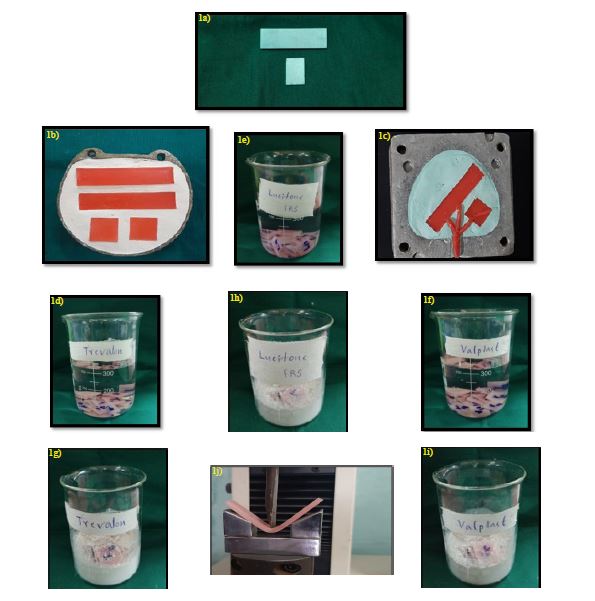
a) Die preparation: To assess water sorption and solubility, a master die composed of a stainless-steel block (FIG-1) measuring 20 x 20 x 1.5 mm was constructed.1 A master die made of a stainless steel 1 block measuring 70 x 15 x 3 mm was ready to be used in the flexural strength test.2
b) The sample preparation: The polymethyl methacrylate specimens were fabricated using the compression molding technique, and the flexible resin specimens were fabricated using the injection molding technique.
• The mold was fabricated using the addition silicone putty material for making the wax blocks. Once the wax blocks were obtained, they were invested in flasks, followed by dewaxing procedures.
• Conventional resin and thermoplastic resin were packed according to the manufacturer's instructions and subjected to curing cycles.
• After completion of curing, the samples were retrieved and finished for smooth borders, and their dimensions were evaluated using vernier calipers.
c) Testing of Samples: Sorption testing was carried out through subsequent reduction of each block to approximately 0.5 mm using abrasive papers of successive grits of 120, 240, 400, and 600 to ensure the accurate dimensions of the sample, which was confirmed using digital vernier calipers. To make sure the square block's surfaces were parallel and level, the samples were ground. During the grinding processes, water was poured over abrasive papers.1
After the grinding process was finished, square blocks were dried for 24 hours at 37 ± 2 °C in desiccators filled with anhydrous calcium chloride. After one hour at room temperature in a comparable desiccator, each block was then precisely weighed to the nearest 0.2 milligram. Each block lost no more than 0.5 mg of weight in a 24hour period. After that, the blocks were submerged in distilled water for seven days at 37 ± 1°C. After this time, each block was taken out of the water using forceps, dried with a fresh towel, and allowed to air dry for 15 seconds before being weighed.1
Next, the average readings for every block were noted, with a precision of 0.01 mg/cm^.2 These blocks were then utilized once more for solubility test values. After that, the blocks were reconditioned to a constant weight using the previously mentioned desiccation methods.
For Flexural strength
The samples retrieved were then subjected to a 3-point bending test in a universal testing machine and the values are noted. The values will be calculated by using the formula.
Statistical Analysis:The data was obtained after sub-jecting samples to consecutive tests, the final result was calculated by using the below mentioned formulas.
a. Water sorption:
Sorption (µg/cm²) = {mass after immersion
(µg) – dry mass (µg)} / surface area (cm²)
b. Solubility:
Solubility (µg/cm²) = {dry mass (µg) – reconditioned mass (µg)} / Surface area (cm²)
c. Flexural strength:
Solubility (µg/cm²) = {dry mass (µg) – reconditioned mass (µg)} / Surface area (cm²)
Where, P- ultimate load at which the materials fractured. (in N), L - Span length (mm), b -Specimen width (mm), d -Specimen thickness (mm).
Then the obtained data was subjected to statistical analysis using the ANOVA test followed by Tukey's post hoc test for multiple group comparisons.
Results
A total of 120 samples were included in the study to evaluate all the parameters mentioned. The values obtained are tabulated as mentioned below.
Table 1 shows multiple comparisons (Tukey's post hoc) between water sorption values of all the materials employed in the study. The P-value obtained was<0.0001**. Hence the results obtained were statistically significant.
Table 2 shows multiple comparisons (Tukey's post hoc) between solubility and values of all the materials employed in the study. The P-value obtained was <0.0001**. Hence the results obtained were statistically significant.
Table 3 shows multiple comparisons (Tukey’s post hoc) between the flexural strength values of all materials employed in the study. The P-value obtained was <0.0001**. Hence the results obtained were statistically significant.
Table 4 shows Valplast demonstrates the best properties with lowest water sorption and solubility and highest flexural strength. Trevalon HI is least favorable due to highest water uptake and solubility. Lucitone FRS is intermediate in water properties but similar in strength to Trevalon HI. Overall, Valplast is the most durable and moisture-resistant material.
Discussion
Polymers are widely employed in many different applications, including dental implants and dentures. The main goals of prosthetic replacements for individuals who were either completely or partially edentulous were to restore the physiological and aesthetic functions of their oral tissues.4 Since its introduction to dentistry, acrylic resins have been the only substance to match the appearance of the soft tissues of the mouth with such fidelity. Its overall performance is regarded as satisfactory, and it is widely used for the fabrication of complete dentures.1,5
The shelf life of acrylic resin material is difficult to predict since many environmental factors affect its durability.3 Most denture-base resin materials consist of poly (methyl methacrylate), poly (ethyl methacrylate), and other copolymers.4 For many years, polymethyl methacrylate resin has been used in dentistry successfully. Although it has a number of benefits, including easy processing, precise fit and stability in the oral environment, superior aesthetics, and the flexibility to be used with low-cost equipment, its mechanical and physical qualities are still lacking.6
Nevertheless, a number of clinical investigations, including more recent reports on denture fractures during service, have shown that polymethyl methacrylate's (PMMA) mechanical qualities are inadequate for the denture base's lifetime.7 One could speculate that the improvements in physical properties would lead to superior clinical performance. To get over the drawbacks of polymethyl methacrylate resin, it was necessary to introduce fresh materials with improved flexibility as well as good physical and mechanical qualities.8
The introduction of polymers that resemble nylon has become the more popular choice for denture base materials. These are commonly called thermoplastic resins. This material replaces the metal framework and is feasible enough to build a standard framework of removable partial dentures.9 The material is nearly unbreakable and aesthetically superior, as the coloring mimics the natural gums.10
Nylon, made of polyamide or polyacetal, is a thermoplastic. In the 1950s, they were first exposed to dentistry. Thermoplastic resins have the following indications: complete dentures, orthodontic equipment, mouth guards, splints, anti-snoring devices, prefabricated clasps, partial denture frameworks, temporary or provisional crowns, and bridges.
Compared to traditional PMMA, thermoplastic resins have a number of benefits, including the ability to exhibit excellent wear characteristics, solvent resistance, high creep resistance, stability, resistance to thermal polymer unzipping, and high fatigue endurance. Over the past ten years, significant progress has been made in the therapeutic application of these materials.11 Generally speaking, thermoplastic resins contain very little to no free monomer. For the large portion of the population that is sensitive to free monomers, these materials provide a new, safe therapy option. Furthermore, thermoplastic materials have nearly zero porosity, which results in less biological material accumulation, odors, and stains, as well as improved dimension and color stability.12
The ability of denture base materials to withstand functional masticatory stresses can be indicated by their flexural strength, an essential feature. It is measured using a three point flexural test, which mimics the stress exerted on the denture during mastication and is helpful for comparing denture base materials. Since alveolar resorption is a slow, irregular process that results in uneven prosthesis support, high flexural strength is essential to the success of denture wear.4
The study included a total of 120 samples, which were distributed into 20 per group among six groups of the three materials. The purpose of the square blocks was to test the acrylic samples' solubility and water sorption. Several authors have tested the samples by immersion technique in distilled water for a period varying from 30 minutes to one year for evaluation. However, most of the authors have used the storage duration of seven days as a constant time to assess sorption-solubility values.1,13 The tests were conducted mainly according to American Dental Association Specification No. 12 / ISO: 1567- 1981 (ISO: 6887-1986) for denture base acrylic resin.14
The desiccator used in the study while measuring sorption solubility values was calcium chloride powder. Desiccators are substances that are also called dehumidifiers which help to absorb the moisture from the materials immersed in them. There are two kinds of desiccants available. They are available both in natural and synthetic forms. Other classifications include solid and liquid desiccators.15
Flexible resins are indicated in cases where aesthetic requirements cannot be met by other types of dentures because of biomechanical or physiological reasons or the patient's will.
Recommendations for the Study
Flexible resins find extensive use, and most research have been conducted on the material's mechanical and physical characteristics. It is advised that further research as well as long-term clinical trials can be carried out for improved evaluation and material improvisation for extended use.
Limitations of the Study
1. The present study was performed by using square and rectangular acrylic blocks based on ADA specifications. Further studies should be done on the simulated denture bases.
2. The present study included the fabrication of wax patterns for acrylic block fabrication which might include some amount of processing errors. However accurate fabrication of samples is a must to assess the appropriate results.
Conclusion
Based on the findings of the tests conducted, thermoplastic or flexible materials outperformed conventional resin materials in terms of water sorption, solubility, and flexural strength. The main problems with employing traditional resin materials were resolved by the thermoplastic materials. They are better option for a variety of clinical applications due to their excel lent superior quality in particular physical and mechanical features. Therefore, the use of thermoplastic or flexible resin material is highly recommended in day-to-day practice.
Supporting File
References
1. Pande Neelam Abhay, Shori Karishma. Comparative Evaluation of Impact and Flexural Strength of Four Commercially Available Flexible Den ture Base Materials: An In Vitro Study. J Ind ian Prosthodont Soc. 2013; 13(4):499-508.
2. Jay Shah, Nilesh Bulbule, Shilpa Kulkarni, Riddhi Shah et al. Comparative Evaluation of Sorption, Solubility, and Microhardness of Heat Cure Poly-methylmethacrylate Denture Base Resin & Flexible Denture Base Resin: Experimental Research. J Clin Diagn Res 2014; 8(8): ZF01-ZF04.
3. Suleyman Hakan Tuna, Filiz Keyf, Hasan Onder Gumus et al. The Evaluation of Water Sorption/ Solubility on Various Acrylic Resins. Eur J Dent. 2008; 2.
4. Hamouda IM and Gomaa Faramay AM. One Year Water Storage Flexural Properties of Vertex Thermosens vs Conventional Denture Base Materials: Research article. Austin J Dent .2018; 5(1): 1095.
5. Wong DM, Cheng LY, Chow TW, Clark RK. Effect of processing method on the dimensional accuracy and water sorption of acrylic resin dentures. J Prosthet Dent 1999;81(3):300-4.
6. Nadira A. Hatim, Amer A. Taqa, Sufian A. Y. Modification of heat cured acrylic resin by using additives to make a flexible acrylic resin denture base material: A pilot study. Edorium J Dent 2016;3:1-11.
7. Hae-Hyoung Lee, Chung-Jae Lee and Kenzo Asa-oka. Correlation in the mechanical properties of acrylic denture base resins. Dent Mater J.2012; 31(1): 157-164.
8. T. E. Donovan, R. G. Hurst, and W. V. Campagni. Physical properties of acrylic resin polymerized by four different techniques. J Prosthet Dent 1985; 54(4).
9. FX Ady Soesetijo, Dwi Prijatmoko and Lusi Hi-dajati. Biocompatibility of Thermoplastic Nylon Flexible Removable Partial Denture - A Review. Int J Curr Res Aca Rev 2016; 4(10): 75-83.
10. Singh JP, Dhiman RK, Bedi RP, Girish SH. Flexible denture base material: A viable alternative to conventional acrylic denture base material. Contemp Clin Dent 2011;2(4):313-7.
11. Nandal, Shikha & Ghalaut, Pankaj & Shekhawat, Himanshu et al . (2013). New Era in Denture Base Resins: A Review. Dental Journal of Advance Studies. 01. 10.1055/s-0038-1671969.
12. Negruțiu ML, Românu M, Pop DM. Thermoplastic resins for flexible framework removable partial dentures 2005
13. Cucci AL, Vergani CE, Giampaolo ET, Afonso MC. Water sorption, solubility, and bond strength of two autopolymerizing acrylic resins and one heat-polymerizing acrylic resin. J Prosthet Dent. 1998;80(4):434-8
14. Rajanikanth A, Pandey V, Singh R, et al. Comparison of flexural strength and surface roughness of two different flexible and heat cure denture base material: an in vitro study. J Contemp Dent Pract. 2018;19(10):1214-1220.
15. anda Kishore PVR, Dilip D. Experimental analysis of a liquid desiccant dehumidifier using aqueous calcium chloride solution. Int J Innov Res Sci Eng Technol. 2015;2013:604-610.