RGUHS Nat. J. Pub. Heal. Sci Vol No: 12 Issue No: 2 pISSN: 2249-2194
Dear Authors,
We invite you to watch this comprehensive video guide on the process of submitting your article online. This video will provide you with step-by-step instructions to ensure a smooth and successful submission.
Thank you for your attention and cooperation.
1Department of Diet and Nutrition, Adichunchangiri Ayurvedic Medical College Hospital and Research Centre, Bangalore, Karnataka, India
2Dr. Amarnath BVB, Rachana Shareera, Adichunchangiri Ayurvedic Medical College Hospital and Research Centre, Bangalore, India.
*Corresponding Author:
Dr. Amarnath BVB, Rachana Shareera, Adichunchangiri Ayurvedic Medical College Hospital and Research Centre, Bangalore, India., Email: amarnathbariker@gmail.com
Abstract
Background: The autonomic nervous system (ANS) plays a crucial role in regulating various bodily functions, including body temperature. The increasing popularity of mind-body practices like yoga has led to growing interest in their physiological effects. Yogic breathing techniques such as Shitali Pranayama (Sh.P) have been shown to influence ANS activity, promote relaxation, and improve overall well-being. Chronic stress and autonomic imbalance are prevalent in modern society, highlighting the need for effective complementary therapies. Sh.P, with its potential cooling and calming effects, may be beneficial for individuals seeking physiological balance. However, the specific impact of Sh.P on ANS function and body temperature remains understudied. This study provides insights into its potential benefits for physiological regulation and overall health.
Aim: To evaluate the body temperature changes after seven days of Shitali Pranayama (Sh.P) practice.
Method: With written informed consent, 100 healthy subjects aged 18-30 years of either sex participated in the study. Body temperature was evaluated at specific time points following two sessions/events of Shitali Pranayama (Sh.P), each consisting of 21 cycles, interspersed with a single event of Suryabheda Pranayama (Su.P), consisting of 21 cycles. This sequence was repeated for seven consecutive days.
Results: The results showed marked improvements in thermoregulation and autonomic function following Sh.P practice.
Conclusion: This study explores the scientific basis of yogic breathing and represents a step towards integrative health. Further research is warranted to examine the long-term effects and potential applications of Sh.P across diverse populations.
Keywords
Downloads
-
1FullTextPDF
Article
Introduction
Humans are homeothermic, and thermoregulation maintains a stable internal body temperature despite external fluctuations. Body temperature (degree or intensity of heat present in the body) is regulated by the hypothalamus. Sherrington regarded the hypothalamus as the ‘head ganglion of the autonomic nervous system’.1 In recent years, Nauta described the intact hypothalamus as a ‘nodal region’ essential for maintaining homeostasis within the fluctuating environment.1
Normal human body temperature is 36.8±0.4˚C (98.2±0.7˚F). Variations in thermoregulation may lead to pyrexia (rise in temperature).2 Substances that induce pyrexia are called pyrogens, which may be exogenous or endogenous. Pyrexia results from the action of these cytokines on the thermoregulatory centre, increasing prostaglandin synthesis. The prostaglandins act as neurotransmitters causing an increase in cyclic AMP, thereby resetting the hypothalamus thermostat to a higher level, resulting in an elevated body temperature.2
Physiological parameters may cause an increase in body temperature when heat production exceeds heat loss. These include:
. Exercise
. Menstrual cycle (ovulatory phase)
. High environmental temperatures
. Postmenopausal changes.2
Yogasana, a form of exercise that incorporates controlled breathing, influences thermoregulation. A methodical and systematic description of yoga as a means of cultivating spiritual experience appears extensively for the first time in the ‘Yoga Sutras’ of Maharishi Patanjali. Various methods in yoga cater to the needs of different members of society, as each individual is at a distinct level in the birth cycle and evolution.
Pranayama (breath control), practiced as a part of yoga, helps in modulating autonomic output and aids in achieving autonomic balance between the sympathetic and parasympathetic nervous systems.3 Patanjali, the founder of yoga philosophy, described eight types of pranayama.4 Among them, Shitali Pranayama is derived from the Sanskrit root word ‘shitala’, which means ‘cooling’ and produces a cooling effect on the body.5 In contrast, Suryabheda Pranayama (‘Surya’ means ‘the Sun’), activates the Surya Nadi, or the right nostril channel, thereby heating the body.5
It is important to focus on maintaining our health and well-being, and thus the Ministry of Ayush encourages people to practice these breathing techniques, which help relax the mind and strengthen the body. Thus, yoga offers an appropriate response to the modern world’s quest for a healthy body, mind, and spirit.
Materials and Methods
The study was conducted in accordance with the ethical standards of the responsible committee, and written consent was obtained from all participants.
. Sample size: 100 subjects
. Duration of the study: Seven days
. Instrument: Digital thermometer
. Location: Yoga Hall maintained at normal room temperature
. Additional note: Subjects were trained for one week in the techniques of Shitali Pranayama (Sh.P) and Suryabheda Pranayama (Su.P) prior to the study.
Inclusion and Exclusion Criteria
• Healthy individuals of either sex between the ages of 18 and 30 years were included.
• Individuals suffering from low blood pressure, asthma, cold, cough, or other respiratory-related problems were evaluated and excluded, as they are contraindicated for performing Shitali Pranayama (Sh.P).
• Female volunteers were excluded during the period beginning three days prior to and ending three days after their menstrual cycle.2
Step 1
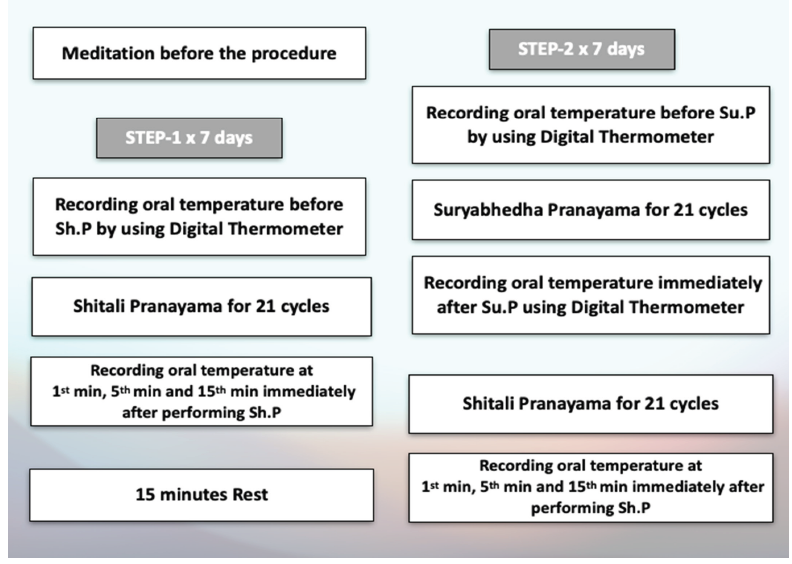
The subjects were instructed to perform Sh.P for 21 cycles, and their oral temperatures were recorded before and immediately after performing Sh.P at 1st, 5th, and 15th minutes using a digital thermometer (Figure 1).
Interval -15 minutes for rest.
Step 2
The subjects were instructed to perform Su.P for 21 cycles, and oral temperatures were recorded before and immediately after performing Su.P using a digital thermometer.
Step 3
Immediately after step 2, the subjects were instructed to perform Sh.P again for 21 cycles, and oral temperatures were recorded at the 1st, 5th, and 15th minutes using a digital thermometer. This cycle was repeated for seven days.
Daily data of the study were recorded in tabulated form as shown above in Table 1, for all seven days.
To obtain the results, the documented temperature readings were statistically analyzed using a paired sample t-test to calculate the means of the two groups and repeated-measures ANOVA’ to analyze changes within the subjects.
Results
T-test and repeated measures ANOVA methods were applied to the data. The comparisons were made between:
1. Pre- and post- values of one cycle of Su.P
2. Pre- and post- values of two events of Sh.P
3. Pre-Su.P values and post-second event Sh.P values
Comparison of pre- and post-values for Suryabheda Pranayama is presented in Table 2.
Temperature changes before and after Shitali Pranayama at different intervals (1st, 5th, and 15th minutes) are summarized in Table 3.
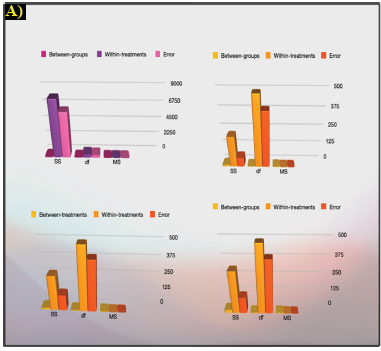
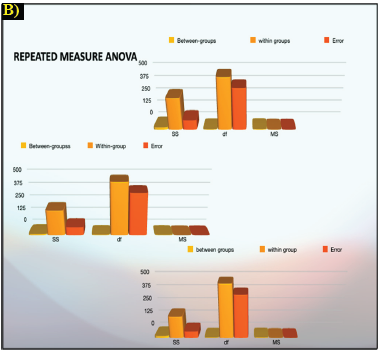
Variations between groups and treatments were analyzed using repeated-measures ANOVA, as shown in Figure 2A and 2B.
The combined effect of Suryabheda and Shitali Pranayama is detailed in Table 4.
As there was a gradual return to the baseline temperature, the observations were subjected to repeated-measures ANOVA to test for significance. The f-values showed significant differences on all days except Day 4, allowing the null hypothesis to be safely rejected.
Discussion
Physiological Regulation of Body Temperature
1. Heat is produced in the muscles both at rest and during activity. During rest, heat arises from muscle tone, whereas during muscular activity, it is referred to as the heat of activity. About 80% of this heat is produced by skeletal muscles.6 During certain forms of pranayama that involve rigorous use of respiratory muscles, body temperature increases by muscular activity, increases the ventilation by stimulating the respiratory centers.7 This rise in body temperature is effectively counterbalanced by practices such as Shitali Pranayama.5
2. The rate of diffusion is directly proportional to body temperature. As temperature rises, the thermal motion of molecules increases, thereby accelerating the rate of diffusion.8
3. Body temperature must be maintained around 37.5°C. Deviations from this range can alter metabolic activity of the cells. The skin, respiratory system, digestive system, excretory system, skeletal muscles, and nervous system collectively contribute to maintaining temperature within normal limits.9
4. Owing to its high specific heat, blood plays a key role in thermoregulation by maintaining the balance between heat loss and heat gain. Both Suryabheda and Shitali Pranayama play significant roles in influencing heat loss and heat gain, thereby directly affecting body temperature.10
5. The skin plays an important role in the regulation of body temperature. Excess heat is lost through radiation, conduction, convection, and evaporation. The sweat glands in the skin contribute to heat loss by secreting sweat. Most other types of pranayama generate heat due to rigorous respiratory activity, whereas Shitali Pranayama pacifies the system and results in a lowered body temperature. It can be safely hypothesized that the heat and sweat produced during other types of pranayama are counterbalanced by the cooling effect of Shitali Pranayama.11
6. Role of hormones - Thyroxine and adrenaline increase heat production by accelerating metabolic activities.6
Factors Affecting Body Temperature
1. Influence of age on temperature
In infants, body temperature varies according to environmental temperature during the first few days after birth because the temperature-regulating system is not yet fully functional. In children, the temperature is slightly higher (0.5°C) than in adults due to greater physical activity. In old age, reduced heat production leads to slight decrease in body temperature. Regular practice of different pranayama aid in maintenance of body temperature, which would otherwise be affected by age-related changes.6
2. Sex
Scientific studies indicate that females generally have a slightly lower body temperature than males due to a lower basal metabolic rate. During the menstrual phase, temperature fluctuates. It decreases slightly during menstrual cycle, while immediately after ovulation, the temperature rises sharply (0.5°C to 1°C).6 This validates the reference in Sushruta Samhita that states “Artavam agneyam”, and suggests that practice of Pranayama may help mitigate untoward effects associated with temperature variations. Progesterone increases body temperature after ovulation. The mechanism of thermogenic action is not fully known. It is suggested that progesterone increases the body temperature by acting on hypothalamic centers for temperature regulation.12
Body temperature is often monitored for several days during the mid-menstrual cycle by measuring basal temperature in the morning, using a thermometer placed in the rectum or vagina. A slight fall in the basal temperature occurs just before ovulation, followed by an increase afterward. These alterations in the temperature are very mild ranging from about ±0.3°C to 0.5°C, and are attributed to the thermogenic effect of progesterone.13 Pranayama, especially Shitali Pranayama, may influence neuroendocrine pathways and thereby help reduce body temperature.14
3. Diurnal factors
In the early morning, body temperature is approximately 1°C lower, whereas in the afternoon, it reaches its maximum, about 1°C above normal.13 This physiological observation justifies the Ayurveda principle that the afternoon period is characterized by Pitta predominance.5
4. Food
Body temperature rises slightly (0.5°C) after meals,which aligns with the Ayurvedic principle of Pitta vriddhi after consumption of food.6
5. Emotion
During intense emotional states, body temperature rises.6 Shitali Pranayama helps calm both the body and mind, contributing to a reduction in body temperature.5
Body Temperature in Altered Physiology / Pathology
Thyroxine and adrenaline increase heat production by accelerating metabolic activities.6 Regular practice of Shitali Pranayama may help regulate the secretion of thyroxine, potentially offering supportive benefits in conditions such as hyperthyroidism. This observation paves the way for future research on the influence of Pranayama on thyroid disorders and, by extension, other hormones as well.5
Discussion on the Study
The study was conducted in three stages, with the objective of each step being to assess the temperature changes following Suryabheda Pranayama, to observe the temperature changes before and after Shitali Pranayama, and to evaluate the efficacy of Shitali Pranayama in reducing the temperature elevated by Suryabheda Pranayama.
Discussion on the Observation
1. In the first step, there was a significant change in body temperature, leading to the rejection of the null hypothesis of no change/reduction in body temperature after Shitali Pranayama. This was evident in both the t-test and repeated-measures ANOVA. The temperature remained low up to 15 minutes after Shitali Pranayama on all seven days of the study.
2. In the second step, the influence of Suryabheda Pranayama on body temperature was assessed using the t-test and repeated-measures ANOVA. The null hypothesis was rejected on four days, indicating a significant rise in body temperature. Similarly, manual comparison of pre- and post-values and examination of mean values showed an increase in temperature in more than 50% of the participants.
3. In the third step, the effect of Shitali Pranayama after preforming Suryabheda Pranayama was evident in both t -test and repeated-measures ANOVA, with significant changes in body temperature leading to rejection of the null hypothesis on all seven days. The results clearly showed a reduction in body temperature after Shitali Pranayama and concurrently there was increase in the temperature following Suryabheda Pranayama. For added specificity, Shitali Pranayama was also practiced independently, during which a reduction in the body temperature was consistently observed. In cases with increase in body temperature after Suryabheda Pranayama, subsequent practice of Shitali Pranayama produced a significant reduction in temperature. Thus, it is reasonable to hypothesize that Shitali Pranayama reduces body temperature, whereas Suryabheda Pranayama increases it. In most observations, the change is temperature persisted for more than 15 minutes.
Conclusion
• The findings indicate Shitali Pranayama’s benefits in enhancing parasympathetic activity and thermoregu-lation, supporting its use as a complementary therapy for overall well-being.
• These results highlight its relevance for health and wellness by promoting autonomic balance through its cooling and calming effects.
• The literature review suggests that body temperature is affected by neuroendocrine pathways, with signifi-cant roles played by hypothalamic, pituitary, thyroid, and gonadal hormones. Hence, it may be hypothesized that there is considerable scope for clinical trials on disorders of endocrine system in relation to different patterns of Pranayama.
• The data also support the claim that Sh.P reduces body temperature, with the effect sustained for up to 15 minutes.
• The study further demonstrates that despite elevating body temperature through Su.P, subsequent practice of Sh.P produced the same temperature-reducing effect as observed during the first cycle of Sh.P.
• The data and the observations from this study may serve as a guiding parameter for utilizing these two procedures in the management of fever, warranting further investigations through blinded studies and randomized clinical trials.15
• The real impact of Shitali Pranayama was observed through this small-scale experiment. Further studies with larger sample sizes could provide concrete data and logical conclusions.
Supporting File
 Analysis of between-group, within-group, and error variations for oral temperature changes across different steps of pranayama" width="200px" src="https://hm-journals.s3.ap-south-1.amazonaws.com/home/journals/qjqYX84MXYTuJdNcR9DpwOyKw216J8cz13k3Evbb.png">
 Analysis of between-treatment and within-treatment variations for oral temperature changes across time intervals" width="200px" src="https://hm-journals.s3.ap-south-1.amazonaws.com/home/journals/y23LelC89FGkK2eCYsX4IJtnfqaBWzO47woMDrlu.png">
References
1. Datta AK. The hypothalamus. In: Essentials of human anatomy (Neuroanatomy). 4th ed. Kolkata: Current Books International; 2013. p.115.
2. Mehta PJ, Dr. Mehta NP, Mehta S, et al. The body temperature, In: Common medical symptoms, 7th Edition. The National Book Depot (P); 2017.
3. The Pranayama. Education of Yoga. 2019;13(5):28.
4. Agravala SK. Pranayama types, Chapter 2. In: Hatayoga Pradeepika, Kumbaka bheda, Shloka 44. Varanasi: Choukamba Orientaliya (P); 2013. p. 44.
5. Ranade S, Deshpande R, Bobade RB. Shitali Prana-yama, Chapter 4. In: A textbook of Swasthavr-itta, 1st Edition. Varanasi: Chaukhamba Sanskrit Pratishthan (P); 2017. p. 31.
6. Sembulingam K, Sembulingam P. Body temperature, Chapter 63. In: Essentials of medical physiology, 6th Edition. New Delhi: Jaypee Brothers Medical Publishers (P) LTD; 2012. p. 360.
7. Sembulingam K, Sembulingam P. Effects of exer-cise on respiration, Chapter 32. In: Essentials of medical physiology, 6th Edition. New Delhi: Jaypee Brothers Medical Publishers (P) LTD.; 2012. p. 752.
8. Sembulingam K, Sembulingam P. Transport through cell membrane, Chapter 3. In: Essentials of medical physiology, 6th Edition. New Delhi: Jaypee Broth-ers Medical Publishers (P) LTD; 2012. p. 29.
9. Sembulingam K, Sembulingam P. Homeostasis, Chapter 4. In: Essentials of medical physiology, 6th Edition. New Delhi: Jaypee Brothers Medical Publishers (P) LTD; 2012. p. 39.
10. Sembulingam K, Sembulingam P. Blood, Chapter 7. In: Essentials of medical physiology, 6th Edition. New Delhi: Jaypee Brothers Medical Publishers (P) LTD.; 2012. p. 60.
11. Sembulingam K, Sembulingam P. Functions of skin, Chapter 61. In: Essentials of medical physiology, 6th Edition. New Delhi: Jaypee Brothers Medical Publishers (P) LTD; 2012. p. 355.
12. Sembulingam K, Sembulingam P. Ovary, Chapter 79. In: Essentials of medical physiology, 6th Edition. New Delhi: Jaypee Brothers Medical Publishers (P) LTD.; 2012. p. 480.
13. Sembulingam K, Sembulingam P. Ovulation, Chap-ter 81. In: Essentials of medical physiology, 6th Edition. New Delhi: Jaypee Brothers Medical Publishers (P) LTD; 2012. p. 493.
14. The Pranayama. Education of Yoga. 2019;13(7):30.
15. Lewin M. A powerful pranayama for keeping cool [Internet]. Banyan Blog; 2020 [cited 2024 Dec 30]. Available from: https://www.banyanbotanicals.com